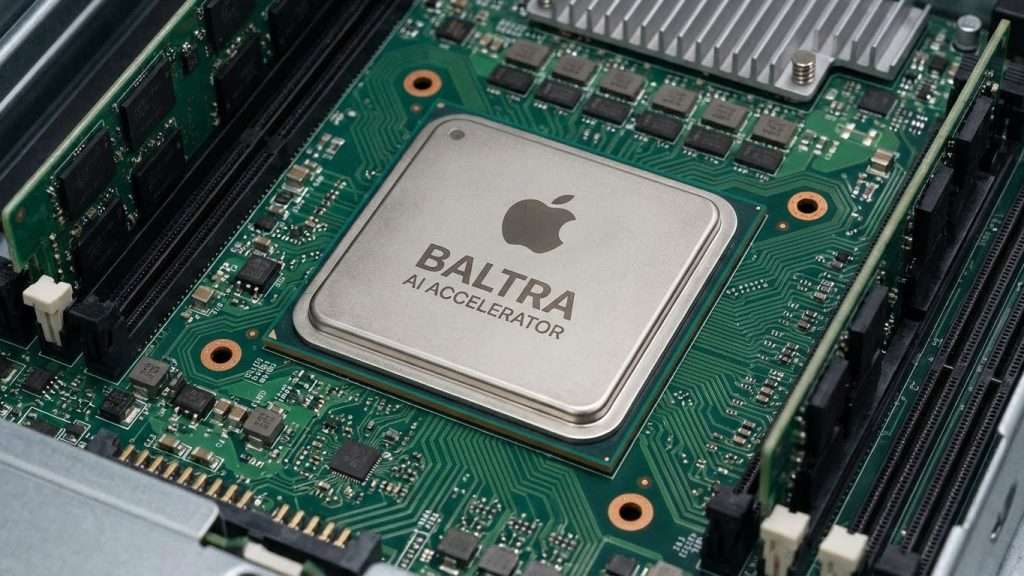
Apple’s New AI Server Chips Entering Production
Apple is reportedly gearing up to start mass production of its in-house server chips, codenamed ‘Baltra,’ in the second half of 2026. These chips are designed primarily for AI inference tasks, marking a significant step in Apple’s expansion beyond its well-known workstation chipsets. This move highlights the company’s ambition to strengthen its AI capabilities by developing custom silicon tailored for server-side AI processing.
Key Features and Advantages of Apple’s Custom Silicon
Apple’s server chips are expected to deliver impressive performance with considerably lower power consumption compared to traditional x86 processors. For instance, the M3 Ultra chip, a top-tier Apple Silicon model, reportedly uses 55 percent less power than its x86 counterparts when running demanding applications like HandBrake. This efficiency is crucial for AI workloads, which require both high computational power and memory bandwidth. By leveraging its expertise in custom silicon, Apple aims to overcome existing bottlenecks in AI processing, potentially enabling more advanced and efficient AI services.
Context: Apple’s AI Strategy and Partnership with Google
This development comes shortly after reports surfaced about Apple partnering with Google to utilise Google’s Gemini AI model for an updated version of Siri. The collaboration suggests that Apple is currently relying on external AI technologies as it builds its own capabilities. Analyst Ming-Chi Kuo points out that Apple faces two short-term challenges in its AI development roadmap, particularly in delivering a more capable on-device AI model. While Apple has made strides with its AI initiatives, the company is still playing catch-up in a field that is becoming central to hardware, operating systems, and user experience.
Kuo draws parallels to Apple’s previous strategy with 5G technology, where the company maintained a partnership with Qualcomm until its own 5G solution was ready for the iPhone 16 series. Similarly, the current partnership with Google is seen as a temporary measure until Apple can launch its own large language model. Despite strong iPhone sales and Apple becoming the leading smartphone brand in 2025, on-device AI is not expected to significantly boost shipments in the near term.
Looking Ahead: What to Expect from Apple’s AI Efforts
While the partnership with Google may ease some immediate pressures, Apple’s long-term goal remains to gain greater control over its core AI technologies. The upcoming in-house server chips are a critical part of this strategy, potentially enabling Apple to deliver more sophisticated AI features with better integration and efficiency. Ming-Chi Kuo anticipates that although mass production of these server chips will begin in late 2026, meaningful advancements in on-device AI capabilities are more likely to emerge from 2027 onwards.
This timeline suggests that Apple is preparing for a future where AI is deeply embedded in its hardware and software ecosystem, enhancing user experience across its devices. Observers should watch closely for further announcements regarding Apple’s AI models and how the company integrates its custom silicon into its broader product lineup.