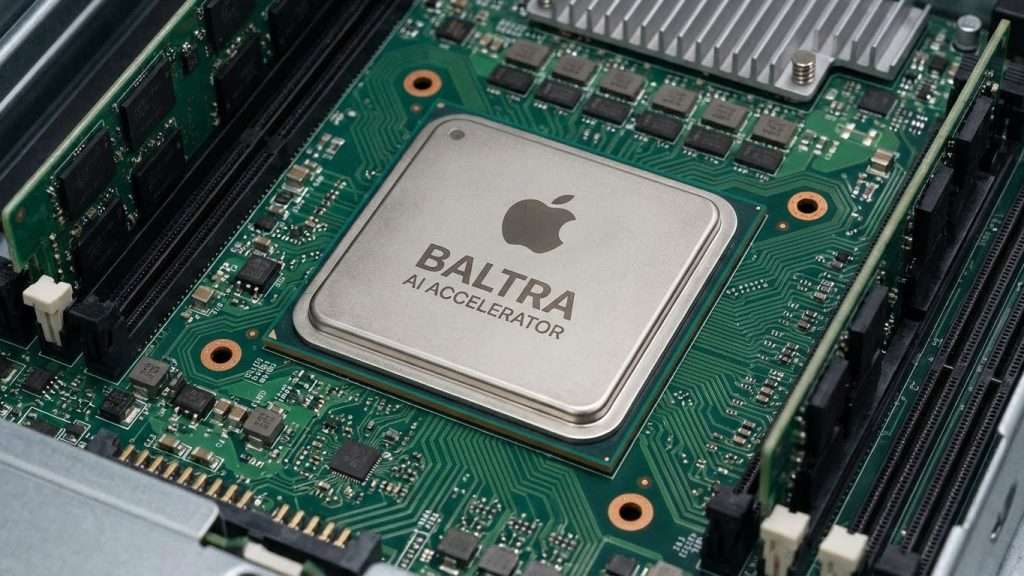
Apple Develops Custom AI Server Chip ‘Baltra’
Apple is reportedly working on its very first AI server chip, internally codenamed “Baltra,” which is expected to debut in 2027. This move aligns with Apple’s well-known strategy of vertical integration, where the company designs and controls key technologies in-house. The Baltra chip is being developed in collaboration with Broadcom, particularly focusing on networking technology to reduce reliance on external suppliers like Nvidia.
Key Details and Expected Features
According to reports from early 2024, the Baltra chip is likely to be manufactured using TSMC’s advanced 3nm N3E process node. Apple’s design efforts for the chip are anticipated to conclude within a 12-month timeframe, with deployment planned for 2027. Apple has already begun shipping its US-made servers as of October 2025, signalling progress towards integrating this new silicon into its infrastructure.
Unlike chips designed for training large AI models, Baltra is expected to primarily handle AI inference tasks. Inference involves using pre-trained models to perform specific functions, such as generating text or interpreting user commands, which demands high throughput and low latency. The architecture of inference chips typically emphasises these factors and often employs lower precision computing methods like INT8 to optimise performance and efficiency.
Context and Apple’s AI Strategy
Apple’s AI ambitions appear to be focused more on inference rather than training large-scale AI models internally. The company has reportedly secured a deal with Google to use a customised 3-trillion-parameter Gemini AI model in the cloud, paying approximately $1 billion annually for access. This partnership suggests Apple will rely on external AI training capabilities while using its own hardware, such as Baltra, to handle the vast inference workloads generated by its services.
Apple’s custom silicon portfolio continues to expand beyond its renowned A-series and M-series processors. The company also designs its own C1 modem chips and is rumoured to be developing derivatives of its Apple Watch S-series chips for upcoming AI smart glasses expected next year. Baltra fits into this broader trend of Apple deepening its hardware control to optimise performance across its ecosystem.
What to Expect Next
As Apple advances with Baltra’s development alongside Broadcom, attention will centre on how this chip enhances AI capabilities within Apple’s cloud infrastructure. The focus on inference-specific design points to a chip tailored for efficiency and scalability rather than raw training power. Observers should watch for further details on Baltra’s architecture and performance as Apple moves closer to its 2027 deployment target.
Overall, Apple’s Baltra chip represents a significant step in the company’s AI hardware journey, reinforcing its commitment to custom silicon and strategic partnerships to meet growing AI demands.