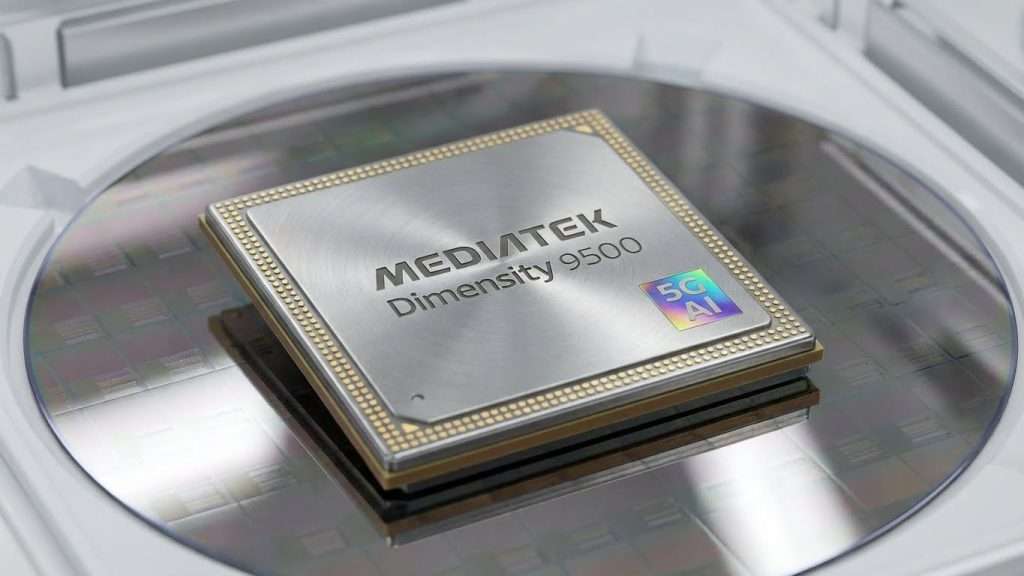
MediaTek’s Bold Move with the Dimensity 9500s Chip
MediaTek has once again demonstrated its innovative spirit with the launch of the Dimensity 9500s chip, taking an unconventional approach to enhance performance. Unlike the trend of using the latest CPU cores, this new SoC adopts older-generation ARM cores but compensates with a remarkably large CPU cache. This strategy aims to balance performance and efficiency in a way that could challenge competitors and influence future chip designs.
Key Specifications and Features
The Dimensity 9500s features an all-big-core CPU configuration, including one ARM Cortex-X925 core clocked up to 3.73GHz with 2MB of L2 cache, three ARM Cortex-X4 cores each with 1MB L2 cache, and four ARM Cortex-A720 cores with 512KB L2 cache. On the graphics side, it is equipped with the Immortalis-G925 MP12 GPU, which supports ray tracing technology, enhancing visual fidelity for gaming and multimedia applications.
Manufactured using TSMC’s advanced 3nm (N3E) process node, the chip also integrates MediaTek’s NPU with agentic AI capabilities, supports LPDDR5x RAM, and utilises UFS 4 storage with Multi-Chip Package (MCQ) technology. These features collectively position the Dimensity 9500s as a competitive option in the mid-to-high-end smartphone segment.
Innovative Cache Design Counters Older CPU Cores
While the Dimensity 9500s uses ARM CPU cores that are at least a generation older than those in the original Dimensity 9500, MediaTek has introduced a standout feature: an exceptionally large CPU cache. The chip boasts a total cache of 19MB, including 12MB of L3 cache and 10MB of System Level Cache (SLC). This is notably larger than the Snapdragon 8 Gen 5’s 6MB L3 and 30MB SLC.
CPU cache plays a critical role in bridging the speed gap between processor cores and slower RAM by storing frequently accessed data directly on the chip. This reduces latency and power consumption, potentially offsetting the performance drawbacks of using older cores. It will be interesting to see how this design choice impacts real-world performance when benchmark results for the Dimensity 9500s become available.
Context and Industry Implications
Recent analysis has highlighted that one reason Google’s Tensor G5 chip lags behind MediaTek’s Dimensity 9500 in performance is due to Google’s choice of older ARM generic cores, which are over two and a half years old. MediaTek’s Dimensity 9500s seems to take a similar path but innovates by leveraging a much larger cache to boost efficiency and performance.
This approach could be a response to rising DRAM costs, offering a way to maintain competitive performance without relying solely on the latest CPU architectures. If successful, it might encourage other chipmakers to revisit older core designs combined with enhanced cache strategies, especially for non-flagship devices where cost efficiency is crucial.
What to Expect Next
As the Dimensity 9500s starts to appear in upcoming smartphones, the tech community will be keenly watching benchmark scores and real-world testing to evaluate the effectiveness of MediaTek’s cache-centric design. This could mark a shift in how chip performance is optimised beyond just core generation and clock speeds.
MediaTek’s innovative gamble with the Dimensity 9500s highlights how thinking outside the box can create new opportunities in chip design, potentially influencing broader industry trends in the near future.
Source: X