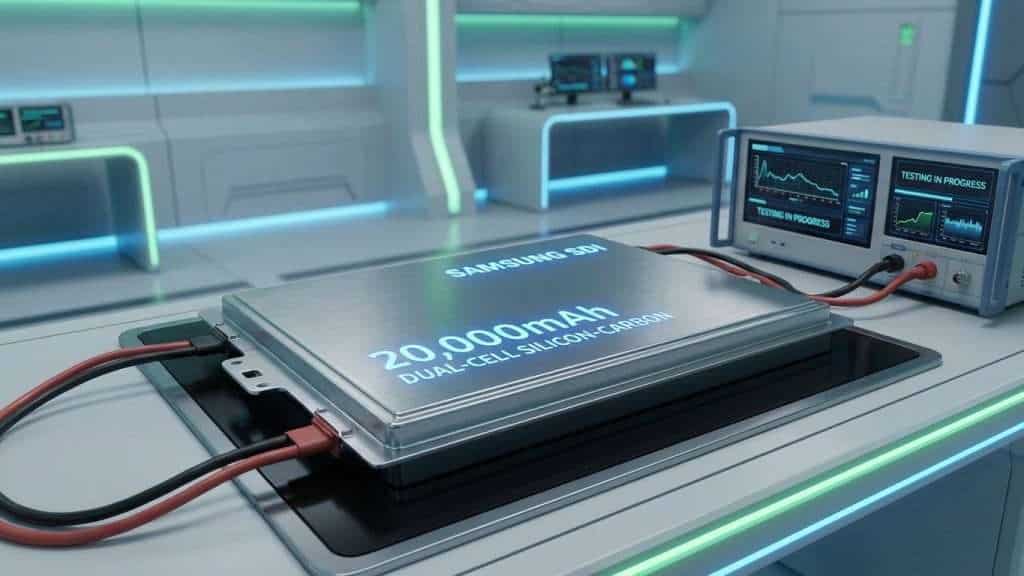
Samsung SDI Explores Next-Gen Silicon-Carbon Battery Technology
Samsung SDI is reportedly experimenting with a groundbreaking dual-cell silicon-carbon (Si/C) battery boasting a combined capacity of 20,000mAh. This development marks a significant leap in battery technology, especially at a time when many Chinese manufacturers are already pushing the boundaries with relatively affordable phones equipped with silicon-carbon batteries of up to 10,000mAh. The new battery under test features a primary cell with a capacity of 12,000mAh and a thickness of 6.3mm, alongside a secondary cell offering 8,000mAh at 4mm thickness, according to information shared by tech insiders @phonefuturist and @SPYGO19726 on X (formerly Twitter).
Understanding Silicon-Carbon Battery Advantages
Silicon-carbon batteries differ from traditional lithium-ion cells primarily in their anode composition. Instead of the conventional graphite, these batteries use a fracture-resistant, nanostructured silicon-carbon composite. This silicon-based anode can accommodate up to ten times more lithium ions, dramatically increasing the battery’s capacity without significantly increasing its size. This technology allows for slimmer battery designs while offering much higher energy density. For context, the iPhone Air’s battery is around 39 percent smaller than the Tecno Pova Slim 5G’s silicon-carbon battery, despite the iPhone being only slightly slimmer overall.
Challenges and Current Limitations
Despite the promising capacity figures, Samsung’s dual-cell silicon-carbon battery is still in an experimental phase. Recent tests revealed that the secondary 8,000mAh cell experienced significant swelling—around an 80 percent increase in thickness—raising concerns about durability and practical implementation. Such issues suggest that widespread commercial adoption of this technology by Samsung remains some way off. Meanwhile, Samsung’s flagship smartphones continue to feature battery capacities around 5,000mAh, a figure that has drawn criticism given the rapid advancements by competitors.
Context and Industry Implications
Chinese OEMs have been aggressively advancing silicon-carbon battery tech, with expectations that 15,000mAh smartphones could launch within the next three years. Samsung’s exploration of a 20,000mAh dual-cell battery indicates its intent to remain competitive in this evolving landscape. However, as noted by industry analyst Ice Universe, Samsung’s current flagship models like the Galaxy S26 Ultra are expected to maintain the 5,000mAh battery capacity, highlighting a cautious approach amid ongoing technical challenges.
As Samsung SDI continues refining this technology, the industry will be watching closely to see how and when these high-capacity silicon-carbon batteries might make their way into consumer devices. The potential for significantly longer battery life and slimmer designs could redefine smartphone endurance in the coming years.
For more insights on emerging smartphone battery technologies, see the detailed discussion shared by Samsung insiders and tech leakers here.
In summary, while Samsung’s dual-cell 20,000mAh silicon-carbon battery is an exciting development, practical deployment remains a future prospect as the company works through current material and design hurdles.