
Exynos 2600 Shows Strong GPU Performance in Early Benchmarks
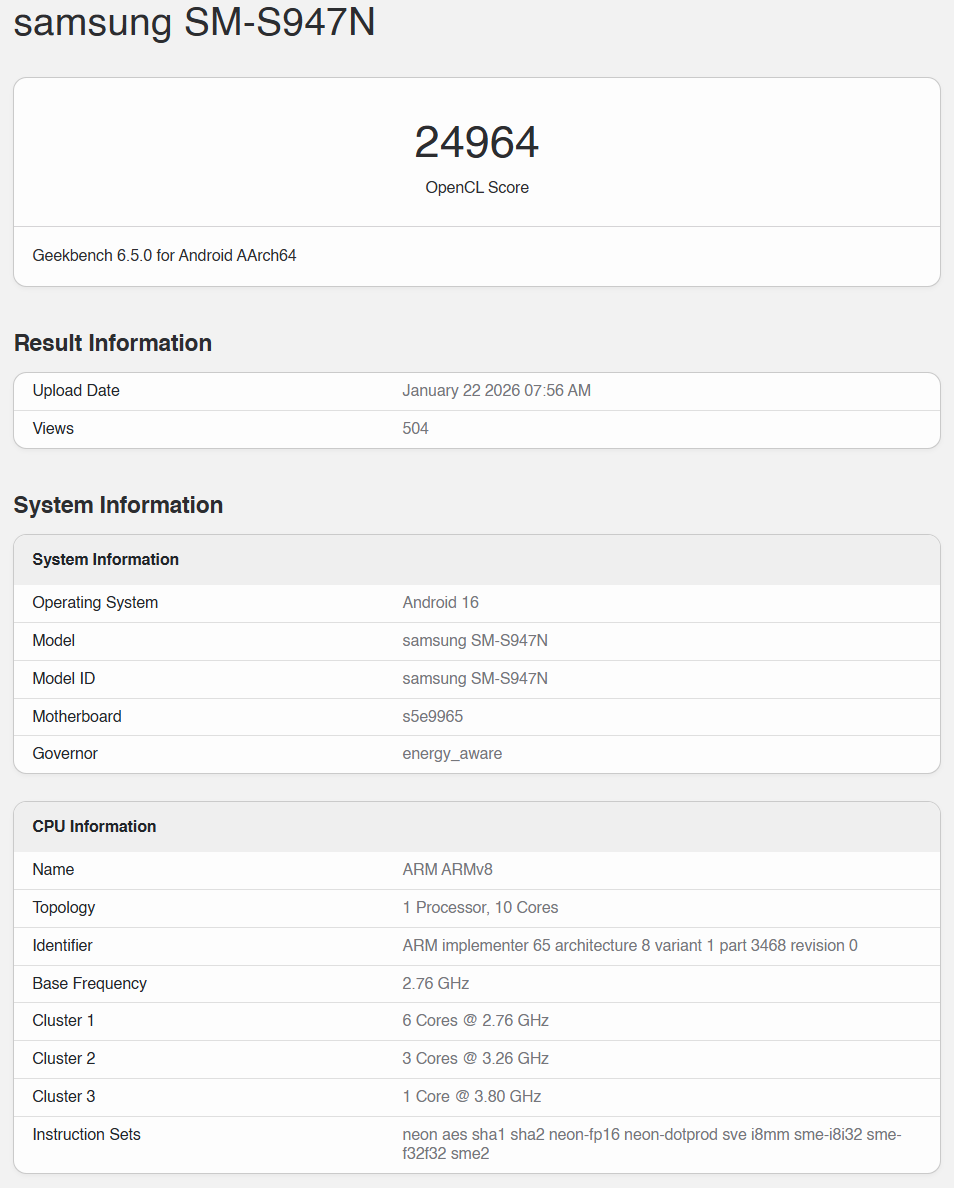
As Samsung gears up for its upcoming Galaxy Unpacked event, early benchmark results for the Exynos 2600 chipset have started to emerge, drawing significant attention. This new SoC is notable for being Samsung’s first to be mass-produced using the advanced 2nm GAA process and for featuring the Xclipse 960 GPU, which is based on a customised version of AMD’s RDNA 4 architecture. Initial Geekbench 6 OpenCL tests reveal that the Exynos 2600 delivers a 21.8% performance lead over Qualcomm’s Snapdragon X Elite, a flagship chipset primarily designed for laptops.
Key Specifications and Benchmark Details
The Exynos 2600’s Xclipse 960 GPU scored an impressive 24,964 points in Geekbench 6’s OpenCL benchmark, surpassing the Snapdragon X Elite’s 20,492 points. This performance gain highlights Samsung’s focus on improving graphics capabilities, with the company previously touting up to a 50% boost in ray tracing performance compared to the previous generation Xclipse 950 GPU found in the Exynos 2500. The Galaxy S25+ model SM-S947N, destined for the South Korean market, was the device tested with the Exynos 2600, confirming the chipset’s integration into Samsung’s next flagship lineup.
However, when the Vulkan API benchmark was run, the Snapdragon X Elite regained the advantage, scoring 28,934 points—approximately 15.9% higher than the Exynos 2600’s OpenCL score. It is important to note that the Snapdragon X Elite was tested on the Galaxy Book4 Edge laptop running in Balanced power mode, which suggests that switching to High Performance mode could yield even stronger results. Meanwhile, official Vulkan scores for the Exynos 2600 are still awaited, leaving some uncertainty about its performance under this different graphics API.
Background and Context on Samsung’s Exynos Chipsets
Samsung’s Exynos processors have historically been met with mixed reactions. While they often boast impressive specifications on paper, real-world performance has sometimes been hampered by issues such as overheating and thermal throttling. Previous flagship models struggled to maintain peak performance despite advanced cooling solutions like vapour chambers. To address these challenges, Samsung is reportedly introducing Heat Pass Block (HPB) technology with the Exynos 2600, which a company executive claims can reduce operating temperatures by up to 30%. This heatsink-like innovation has attracted interest from other chipset manufacturers, according to Weibo tipster Fixed-focus digital cameras.
The Exynos 2600’s use of the 2nm GAA process also marks a significant technological leap, potentially offering better power efficiency and performance compared to older nodes. Coupled with the custom AMD RDNA 4 GPU architecture, this chipset represents Samsung’s renewed effort to compete strongly in the high-end mobile and laptop markets.
What to Expect Next
While the early Geekbench 6 OpenCL results for the Exynos 2600 are promising, the contrasting Vulkan benchmark outcomes suggest that a full picture of the chipset’s GPU capabilities is yet to emerge. The official release of Vulkan scores and real-world testing will be crucial to understanding how Samsung’s latest silicon stacks up against competitors like Qualcomm’s Snapdragon X Elite. With Samsung’s Galaxy S25 series launch approaching, the Exynos 2600 will soon face public scrutiny, and its performance, thermal management, and power efficiency will be closely watched by enthusiasts and industry observers alike.
For now, Samsung’s first 2nm chipset and its Xclipse 960 GPU have made an impressive debut, but the true test will come once the devices hit the market and users put them through everyday workloads.