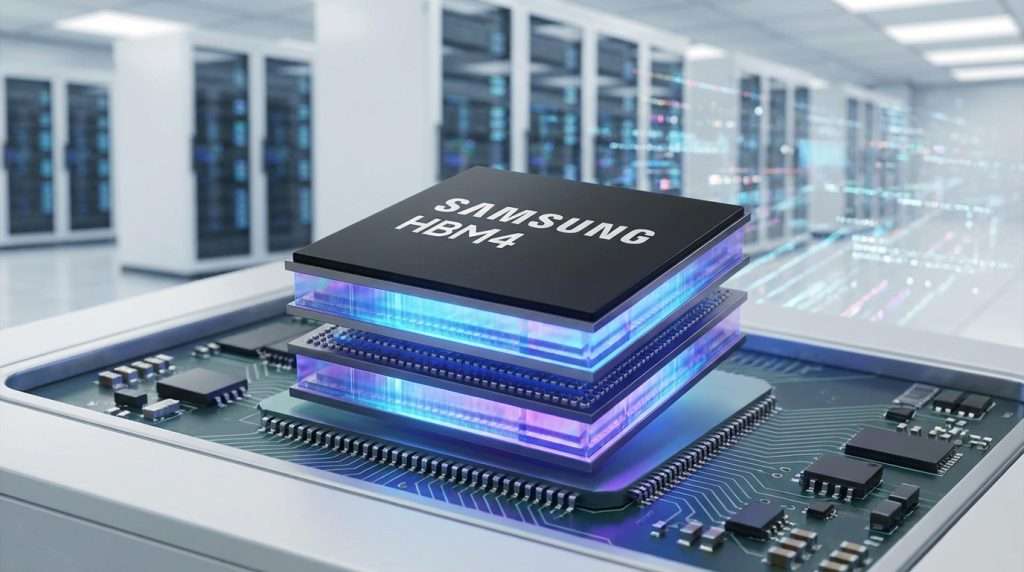
Samsung Begins Mass Production of Advanced HBM4 Memory
Samsung Electronics has officially started the mass production and shipment of its cutting-edge HBM4 memory, marking a significant milestone in the memory technology industry. This new generation of high-bandwidth memory delivers impressive speeds of up to 13 gigabits per second (Gbps) and offers capacities reaching 48 gigabytes (GB) in 16-layer stacks. The move establishes Samsung as a frontrunner in the HBM4 market, providing early access to this advanced memory technology for its customers.
Key Specifications and Performance Enhancements
Built on Samsung’s sixth-generation 10-nanometre-class DRAM process, the HBM4 memory achieves stable yields and top-tier performance without requiring additional design modifications. The standard processing speed is 11.7 Gbps, which surpasses the industry norm of 8 Gbps by approximately 46%, and represents a 22% increase over the previous HBM3E’s maximum pin speed of 9.6 Gbps. Furthermore, the performance can be pushed to 13 Gbps, effectively addressing data bottlenecks that arise as artificial intelligence (AI) models grow larger and more complex.
In terms of bandwidth, a single HBM4 stack can reach up to 3.3 terabytes per second (TB/s), a 2.7-fold increase compared to HBM3E. Samsung offers the memory in 12-layer stacks with capacities ranging from 24GB to 36GB, while 16-layer stacking will expand capacity options up to 48GB to meet future customer demands.
Efficiency and Thermal Improvements
To tackle the challenges of increased power consumption and thermal output caused by doubling data input/output pins from 1,024 to 2,048, Samsung has integrated advanced low-power design technologies directly into the memory die. This results in a 40% improvement in power efficiency compared to the previous generation, achieved through innovations like low-voltage through silicon via (TSV) technology and optimised power distribution networks. Additionally, thermal resistance has been enhanced by 10%, and heat dissipation capabilities improved by 30%, ensuring reliable operation under heavy workloads.
Production Capabilities and Industry Collaboration
Samsung’s extensive manufacturing infrastructure, including one of the largest DRAM production capacities worldwide, supports a robust and agile supply chain capable of meeting the anticipated surge in demand for HBM4 memory. The company employs a tightly integrated Design Technology Co-Optimization (DTCO) approach between its Foundry and Memory divisions, ensuring high quality and yield standards. Its expertise in advanced packaging techniques also helps streamline production and reduce lead times.
Samsung is actively engaging with global GPU manufacturers and hyperscalers to expand technical partnerships focused on next-generation application-specific integrated circuit (ASIC) development. The company expects HBM sales to more than triple in 2026 compared to 2025, and is proactively scaling up HBM4 production capacity accordingly. Looking ahead, sampling for the subsequent HBM4E variant is planned for the second half of 2026, with custom HBM samples anticipated to reach customers in 2027.
Looking Forward
Samsung’s launch of mass production for HBM4 memory sets a new benchmark for high-performance, energy-efficient memory solutions tailored for demanding datacentre and AI workloads. As the company expands production and collaborates closely with industry leaders, the adoption of HBM4 is poised to accelerate, supporting the next wave of computing advancements.