
Galaxy S26 Ultra’s Snapdragon 8 Elite Gen 5 Performance Compared
Samsung’s upcoming Galaxy S26 Ultra has recently appeared on Geekbench 6, revealing that its Snapdragon 8 Elite Gen 5 chipset is running at a slightly overclocked speed of 4.74GHz on the performance cores, compared to the standard 4.61GHz. Despite this modest frequency increase, benchmark results show that the device is outperformed by the REDMAGIC 11 Pro, which uses the same chipset but without Samsung’s overclocking. This surprising outcome raises questions about the actual benefits of Samsung’s approach to boosting chip speeds in its flagship models.
Benchmark Scores and Cooling Solutions
The Galaxy S26 Ultra scored 3,601 points in the single-core test and 10,686 points in the multi-core test on Geekbench 6. Meanwhile, the REDMAGIC 11 Pro achieved higher results, with a single-core score of 3,696 (2.6% faster) and a multi-core score of 11,654 (9.1% faster). One key factor contributing to the REDMAGIC 11 Pro’s superior performance could be its advanced cooling system, which includes liquid cooling and a built-in fan. This active cooling setup likely allows the Snapdragon 8 Elite Gen 5 to maintain higher sustained clock speeds, whereas the Galaxy S26 Ultra’s thermal management might limit its overclocking potential despite the higher peak frequency.
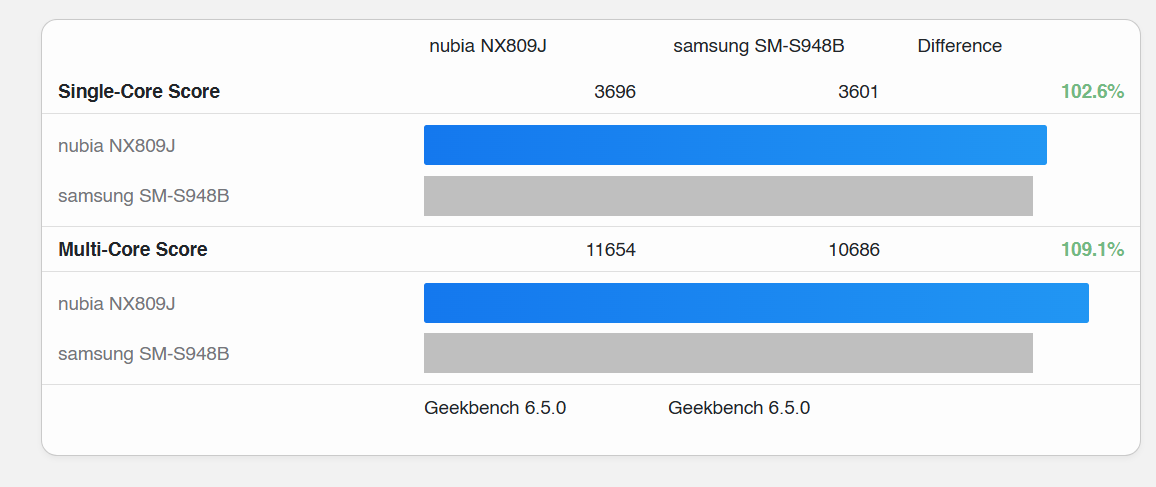
Samsung’s Overclocking Strategy and Chipset Context
Samsung has a history of shipping flagship devices with overclocked Snapdragon processors, but these models often lag behind competitors in raw performance benchmarks. This pattern suggests that Samsung’s overclocking strategy may be more about marketing than delivering a tangible performance edge. However, the company’s ability to optimise Qualcomm’s chipset is inherently limited, as Samsung does not design the Snapdragon SoC itself. In contrast, Samsung’s own Exynos 2600 chipset, built on a 2nm GAA process and based on ARM CPU and GPU designs, might offer different optimisation opportunities. For now, Qualcomm’s Oryon architecture in the Snapdragon 8 Elite Gen 5 appears to hold an advantage in performance.
Looking Ahead
It is important to note that Geekbench 6 is just one of many benchmarks, and real-world performance can vary depending on numerous factors. Additionally, the Galaxy S26 Ultra’s performance could improve once retail units are widely available and receive software optimisations post-launch. As Samsung prepares for its Galaxy Unpacked event, further insights and comparisons are expected to emerge, providing a clearer picture of how the overclocked Snapdragon 8 Elite Gen 5 performs in practice.
For now, the early benchmark results highlight that a higher clock speed does not always translate to better overall performance, especially when cooling and system optimisation play crucial roles.