Samsung SDI Refocuses Battery Development After Setbacks
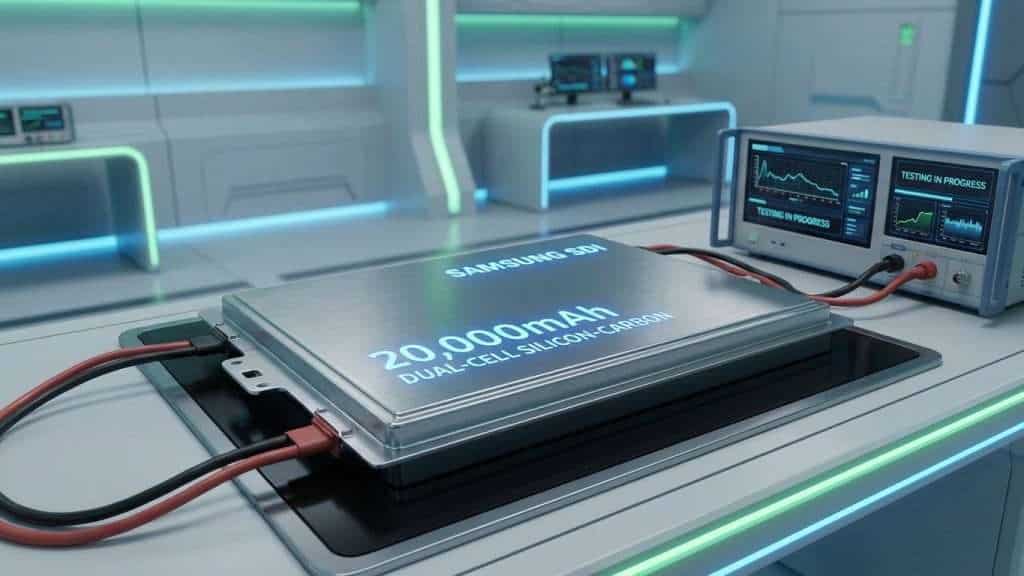
Samsung SDI, the battery division of the South Korean tech giant, has reportedly abandoned its ambitious 20,000mAh silicon-carbon battery project due to significant stability challenges. Instead, the company is now concentrating on developing smaller silicon-carbon batteries with capacities between 6,000mAh and 8,000mAh, which have shown more promising results in early testing. This strategic pivot comes as Samsung faces increasing competition from Chinese manufacturers who have been advancing rapidly in silicon-carbon battery technology.
Key Technical Challenges with the 20,000mAh Battery
The 20,000mAh battery under development was a dual-cell silicon-carbon design, consisting of a primary 12,000mAh cell and a secondary 8,000mAh cell. While the secondary cell maintained a thickness of around 4mm, the main 12,000mAh cell initially measured 6.3mm. However, during testing, the primary cell exhibited significant mechanical swelling, expanding to 8.2mm in thickness. This swelling increased the overall battery thickness to approximately 14mm, nearly matching the outer housing’s size and raising concerns about durability and safety.
Moreover, the 12,000mAh cell suffered from yield degradation and stability issues when charged at high speeds of up to 100W. Samsung SDI’s ultimate goal had been to develop a single-cell 12,000mAh silicon-carbon battery, which would be more efficient than multi-cell designs due to reduced insulation requirements. However, maintaining stability at such high energy densities proved challenging.
Understanding Silicon-Carbon Battery Technology
Silicon-carbon (Si/C) batteries differ from traditional lithium-ion batteries primarily in their anode composition. Instead of using graphite, these batteries utilise a fracture-resistant, nanostructured silicon-carbon composite anode. This material can hold up to ten times more lithium ions than graphite, significantly boosting the battery’s capacity while allowing for a slim form factor. Despite these advantages, scaling up silicon-carbon batteries to very high capacities remains a complex engineering challenge, as demonstrated by Samsung SDI’s recent difficulties.
Looking Ahead: Smaller Batteries and Solid-State Development
Following the setbacks with the large-capacity battery, Samsung SDI is now focusing on silicon-carbon batteries in the 6,000-8,000mAh range, which have shown better yield consistency and more predictable volumetric expansion during initial tests. Alongside this, the company continues to explore solid-state battery technology, which promises further improvements in energy density and safety.
Samsung’s cautious approach to battery innovation, shaped by past incidents such as the Note 7 recall, has led to a conservative development path. However, as competitors push forward with advanced silicon-carbon solutions, Samsung SDI’s renewed focus on more manageable battery sizes could help it regain ground in this critical area.
Overall, the coming months will be crucial in observing how Samsung SDI balances innovation with reliability in its battery technology roadmap.
Source: X