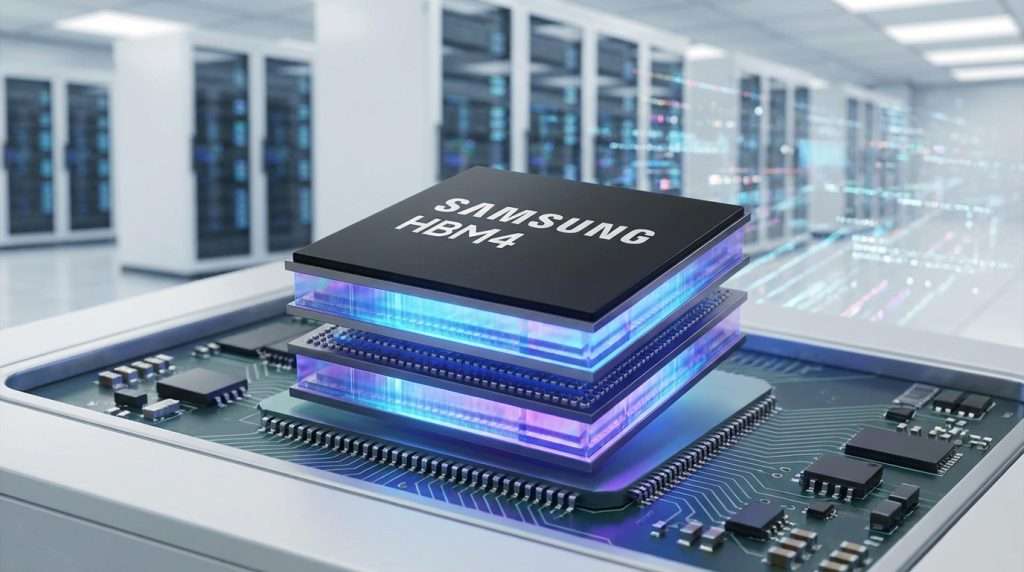
Samsung Launches Industry-Leading HBM4 Memory for AI Applications
Samsung has officially announced the commercial deployment of its latest HBM4 memory, marking a significant milestone in high-bandwidth memory technology. This new generation of memory boasts blazing-fast speeds, reaching up to 13 Gbps through overclocking, making it one of the fastest AI memory solutions currently available. The memory is already being integrated with NVIDIA’s next-generation Vera Rubin AI architecture, highlighting Samsung’s renewed presence in the competitive HBM market.
Key Specifications and Features of Samsung’s HBM4
Samsung’s HBM4 memory is built on the company’s 6th-generation 1c DRAM technology, paired with a 4nm logic die, both developed in-house. The memory achieves an impressive pin speed of 11.7 Gbps under standard operation, which is a 46% increase compared to the previous 8 Gbps standard. With overclocking, speeds can reach up to 13 Gbps, meeting critical performance benchmarks required by NVIDIA. Currently, Samsung is shipping a 12-layer HBM4 configuration, while a 16-layer version is in development that would increase module capacity to 48 GB, significantly enhancing memory density and bandwidth.
Context and Market Positioning
The HBM market has become increasingly competitive, with major players such as SK hynix, Samsung, and Micron vying for dominance. Samsung’s return to the HBM segment with its HBM4 technology represents a strategic push to regain market share. Although Samsung has not explicitly named its customers, it is widely understood that NVIDIA is the primary partner utilising this memory for its Vera Rubin AI infrastructure. NVIDIA’s focus on low latency and optimised response times aligns well with Samsung’s high-performance HBM4 memory, enabling the company to raise the bar in AI computing capabilities.
Looking Ahead: Samsung’s HBM4E and Market Growth
Samsung projects that its HBM revenue will triple in 2026 compared to 2025, signalling strong confidence in its memory solutions. The company also plans to launch HBM4E as early as the second half of 2026, potentially offering even greater performance improvements. While Samsung still trails behind competitors like SK hynix in terms of customer adoption, the advancements in HBM4 technology and its integration with NVIDIA’s Vera Rubin architecture suggest a promising trajectory for the Korean tech giant.
As the AI computing landscape continues to evolve rapidly, Samsung’s HBM4 memory stands out as a critical component in delivering the high bandwidth and low latency required by next-generation AI systems. Observers will be keen to see how Samsung’s ongoing developments influence the broader HBM market and which new partnerships may emerge in the coming months.